

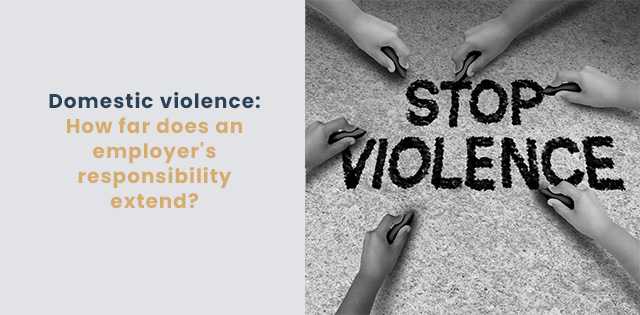
Domestic violence, long perceived as a strictly private matter, is now entering the professional sphere.
While gender-based and sexual violence (GSV) traditionally refers to incidents occurring in the workplace, institutional practice and recommendations now include domestic violence when it affects the health, safety, or working conditions of employees.
As part of the 2023-2025 National Action Plan for the Labor Inspection System, controls on the prevention of GSVI are being strengthened. Inspectors now assess the effectiveness of measures, their implementation, and their adoption by teams.
Between safety obligations, workplace violence prevention, and growing societal expectations, one question arises: how far should companies go?
Should the DUERP include domestic violence?
The impacts on work are very real: absenteeism, anxiety, psychosocial risks, threats on site, and disruption to teams.
More and more employers are choosing to include this risk in their DUERP (single document on occupational risks), considering that it directly affects health and safety at work.
This development is part of a broader trend: domestic violence is now understood as a risk that can be classified as VSS (violence at work) when it interferes with professional life.
Why this change?
- The effects on mental health are immediate.
- Certain situations create a safety risk on site.
- The Labor Inspectorate is paying close attention to this issue.
- HR teams are often called upon to deal with it.
Best practices
- Add a paragraph dedicated to domestic violence.
- Involve the Social and Economic Committee (CSE) in the analysis.
- Describe risky situations.
- Provide for appropriate preventive measures.
How far does the reporting procedure go?
This is one of the most sensitive issues: What should be done when an employee reports violence outside of work that has consequences in the workplace?
Companies must address the report if the situation endangers the employee at work or affects her health.
However, be careful not to:
- Investigate the employee’s private life.
- Take the place of the authorities.
- Focus on protection at work.
Best practices
- A simple and accessible procedure.
- A dedicated channel.
- A trained VSS representative.
- Minimal traceability.
Should managers look out for weak signals?
The subject is often divisive. Some managers fear being “out of their depth,” while others feel helpless.
Managers are not there to investigate, but they must know how to welcome, listen, and guide.
They are often the first to see the signs.
Best practices
- Training for VSS advisors
- Raising awareness among managers
- Providing an internal guide
- Practical case studies for training purposes
Should the company adapt the position of an employee who is a victim?
The answer is now widely accepted: yes, when the situation impacts work.
In this case, there are solutions:
- Adjusted working hours
- Temporary teleworking
- Change of office or team
- Authorized leave
- Referral to specialized associations
Best practices
- Absolute confidentiality
- Coordination with occupational health services
- Regular follow-up
- Documentation of measures taken
Key takeaways
Domestic violence is becoming an issue for businesses.
Combined with stricter obligations regarding workplace safety and increased monitoring, this requires prevention measures that are:
- active,
- documented,
- operational,
- and immediately deployable in risky situations.